What are crypto whales?
Most cryptocurrencies have a number of large holders who can influence the price of the coin. For active investors and crypto traders, it helps to understand the market behaviors.
Crypto whales refer to large holders of cryptocurrencies. They can be individuals or organizations who often own more than 10% of the coin. For instance, MicroStrategy owns nearly 130,000 Bitcoin (BTC) and can move the price of BTC by their market participation. Therefore, tracking the action of crypto whales provides timely insights into the price movement of a crypto asset.

This is not just a crypto phenomenon. In traditional markets, when a big player like Warren Buffett, a brand or a hedge fund reveals that they have taken a position in a particular asset, the price of the asset rallies or vice-versa. That said, when these players sell an asset, the market typically follows.
With cryptocurrencies and NFTs, all transactions are on-chain. Thanks to the transparency that blockchain offers, transactions performed by wallets held by whales can be spotted by the size of the crypto positions they hold. These wallets can be tracked to then understand how the wider market could behave.
What is crypto whale tracking?
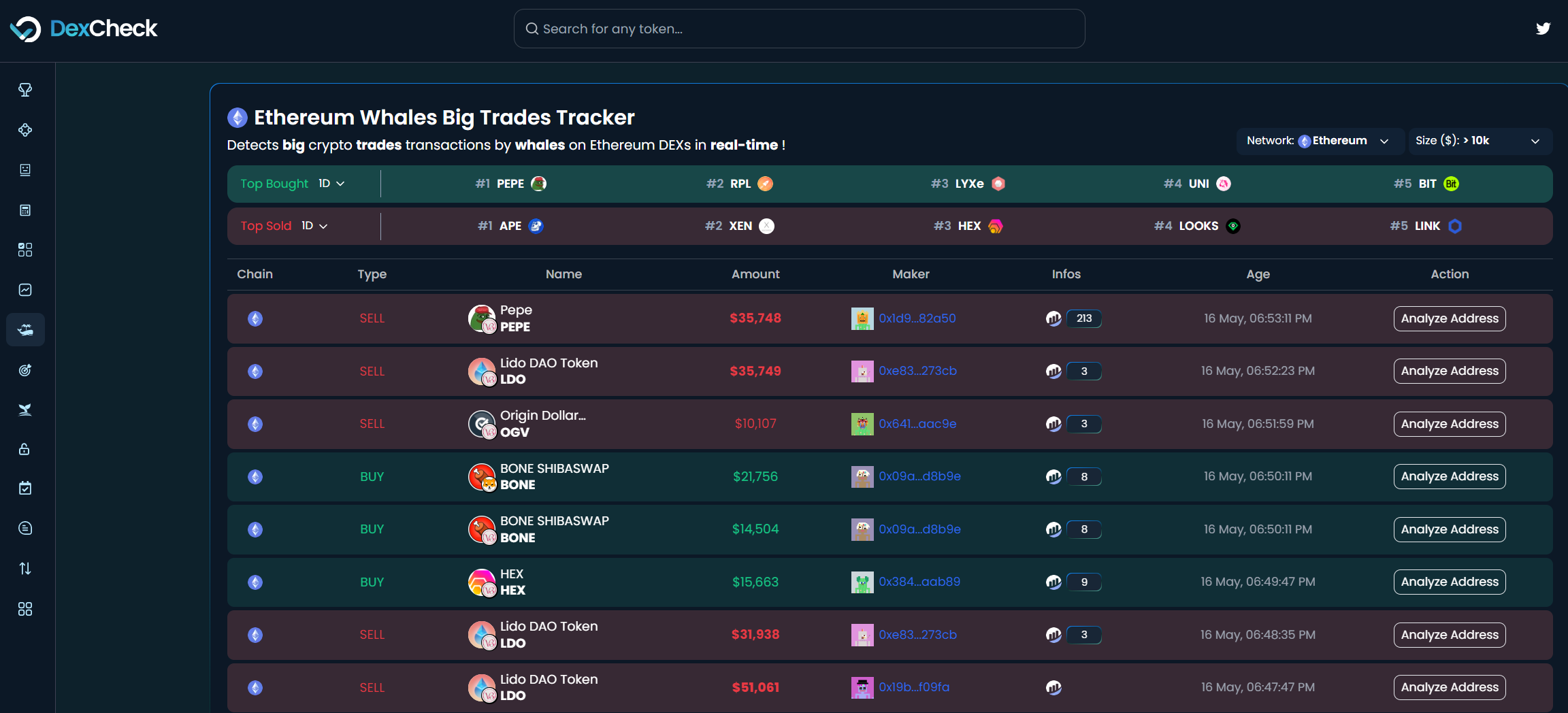
There are dedicated solutions to track the actions of crypto whales. These solutions can provide analytics on whale actions and, in some instances, can also make investment/trading decisions for the user.
Crypto traders and investors constantly track the amount of cryptocurrencies going in and out of exchanges. When a cryptocurrency like Bitcoin or Ether (ETH) is moved in large quantities into an exchange, it is expected to see some sell action resulting in a fall in price. Conversely, if cryptocurrencies flow out of exchanges into wallets, it is considered a precursor to a rise in price.
This is because when exchanges have a high net outflow of cryptocurrencies, they have reduced supply resulting in an increase in price. Oftentimes, a whale could buy cryptocurrencies on an exchange and move them into their wallets in large volumes. This could result in a bullish price action for the crypto.
In some scenarios, whales may choose not to disturb the markets by buying or selling on an exchange. They would do an over the counter (OTC) transaction between two wallets. For instance, they may send Bitcoin to a wallet that will send USD Coin (USDC) back, resulting in a sale of BTC without the market spotting the transaction.
When the blockchain records a large transaction, investors can study the transaction and pick up the wallets involved in it. If the wallets hold large cryptocurrency positions, they can be labeled as crypto whale wallets. From then on, a regular check on these wallets and the transactions that are conducted can be insightful in predicting price movements of the crypto held in the wallet.
Whale tracking can be equally beneficial in the NFT markets too. Most NFT communities have large holders of the collection. In many instances, these NFT holders are identified by the community. Tracking the behavior of wallets of these whales can help investors make quick buy/sell decisions.
For instance, if a famous NFT collector or a whale sweeps the floor of a NFT collection, that can indicate high convictions. Followers of the NFT collection and the whale would notice that and purchase these NFTs. This behavior was noticed with Gary Vaynerchuk several times during the NFT bull market in 2021.
However, it can be overwhelming and time–consuming to manually stay on top of whale action, even when it is just for one cryptocurrency or NFT collection. This is where whale tracking tools come into play.